
The Church of St. Stephen, also known as the Capuchin Church or “Káčko,” is one of Bratislava’s iconic sacred sites. This religious building, with its yellowish facade, includes the monastery of the Order of Friars Minor Capuchin. The church is located on Župné Square at the edge of the historic city center.
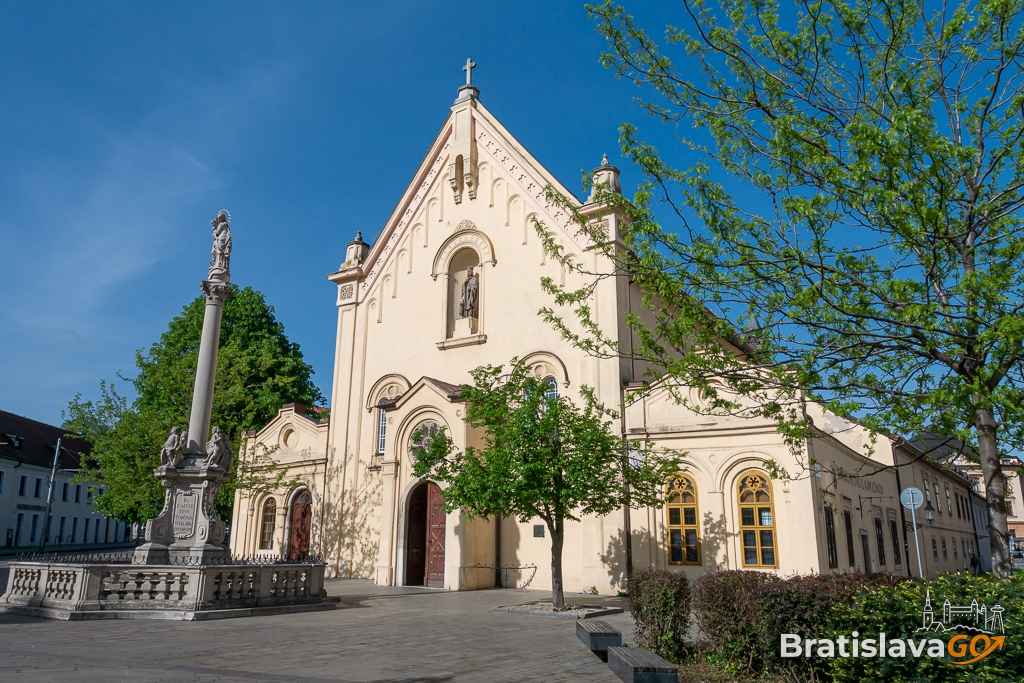
The church is considered a cult site because it has long been a vibrant gathering place for believers of all ages, hosting religious services, weddings, and other spiritual events. The community is very active, and one can often observe young people gathering after youth Masses, discussing faith and life.
Built in the early 18th century, the Church of St. Stephen has remained a lasting part of Bratislava’s sacred architecture. Thanks to the Capuchin order, it continues to be a lively and spiritually rich place that contributes to the surrounding area.
Reaching the Capuchin Church is easy: trams stop right in front of it on Kapucínska Street, and there is a major bus stop nearby on Staromestská Street. While driving is possible, it is inconvenient and parking is limited. The church is also easily accessible by bicycle.
The church’s exterior and interior are relatively modest, reflecting the austere style typical of Capuchin churches. The design blends neo-Romanesque and Baroque elements but emphasizes simplicity over ornamentation.
This approach aligns with the Capuchins’ commitment to poverty, focusing on a rich spiritual life rather than lavish decoration. The church remains a favored place for confession, offering a contemplative space free from distraction.
Notably, the church has no bell tower, which is a characteristic feature of Capuchin architecture, making it unique within the city. Outside, visitors encounter a prominent Marian column on Župné Square. The main entrance leads down a staircase into the nave, and there is also a side entrance through a corridor. The building’s symmetrical, simple contours emphasize its understated elegance.
The Capuchins built the church as their main base after arriving in Bratislava from Vienna. Previously, they had conducted Mass in a small chapel on Michalská Street. Generous donations, particularly from Countess Eleonóra Terézia, helped fund the construction.
A German inscription on the choir commemorates her gift: “Pray for the unworthy founder Eleonóra Terézia, 1709.” Later, Imrich Esterházy financed expansions and repairs, including stabilization work in 1735 due to the marshy foundation.
Ignác Feigler Jr. contributed to the church’s neoclassical facade, while Bratislava sculptor Anton Brandl created the prominent statue of St. Stephen above the entrance.
Inside, the church’s wooden furnishings and Baroque main altar stand out against the pale walls, highlighting the simplicity of its decoration. The altar features a painting of St. Stephen I, placing his son Imrich and the Kingdom of Hungary under the protection of the Virgin Mary. This is symbolized by a royal crown on a cushion.
The painting also emphasizes Bratislava’s significance as a coronation city, depicting landmarks such as St. Martin’s Cathedral, the castle, and the town hall, representing both secular and ecclesiastical authority. The painting, with its relatively dark tones, was most likely created by Capuchin Ulrich of Wels (Thomas Wimberger). Visitors can also notice the choir and organ crafted by Juraj Klökner.
Nearby attractions include the tram tunnel running under Bratislava Castle, which offers a unique technical experience for enthusiasts. For those exploring sacred sites, the Church of the Holy Trinity (Parish Church of St. John of Matha), the historic building of the Slovak National Council, and the views from Michael’s Gate are all within a short distance.