
The Church and Monastery of St. Elizabeth, commonly known among Bratislava residents as the “Alžbetínky,” is located on Špitálska Street in the wider historic center of the city. Built in the mid-18th century, it is recognized as a national cultural monument.
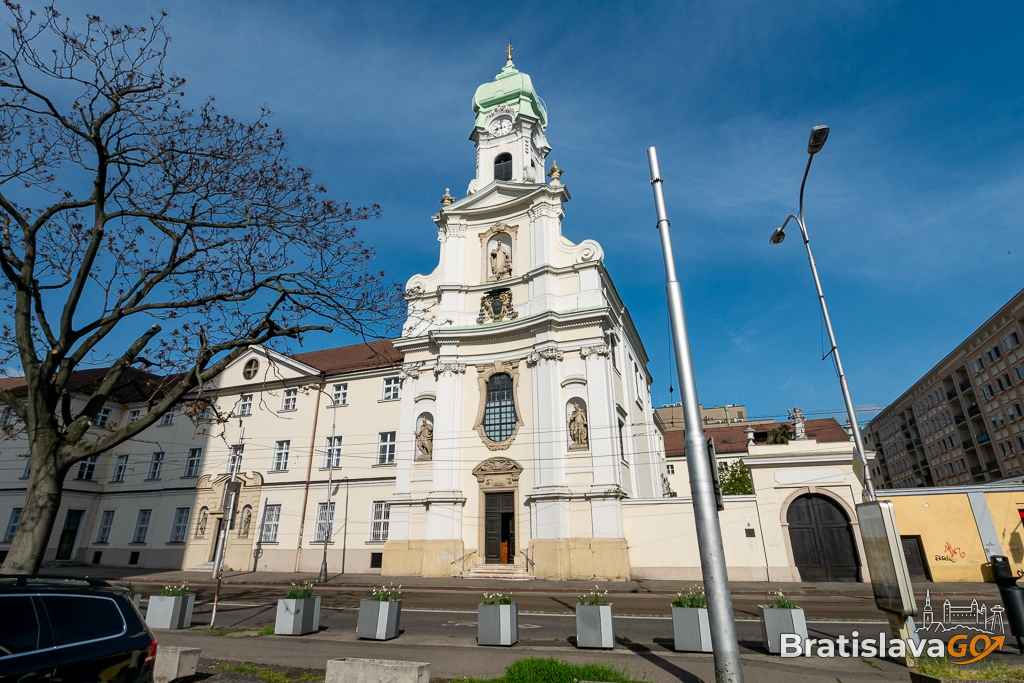
From the outside, the church stands out with its elegant Baroque forms, particularly the prominent greenish tower with a clock and double cross. Its historic appearance contrasts sharply with the modern buildings of Kamenné Square and Špitálska Street.
Its historic value is further enhanced by the nearby Church of St. Ladislaus. Both churches are remnants of an earlier era. The St. Elizabeth Church was designed by the Viennese architect Franz Anton Pilgram.
The church is easily accessible by tram, with a nearby stop. Visitors can also reach it on foot from the historic center, by bicycle, or by car, though parking requires payment.
The Order of St. Elizabeth, the so-called Alžbetínky, came to Bratislava (then Pressburg) from Vienna at the request of Archbishop and Hungarian Primate Imrich Esterházy. Their mission focused primarily on caring for the sick and orphans. Construction of the church, monastery, and hospital began in 1738 and was completed in 1743.
The church interior features decoration by the European-renowned artist Paul Troger, making it a unique work in Slovakia. The exterior is characterized by a stepped façade resembling floors, adorned with statues of St. Ladislaus and St. Stephen by Ľudovít Gode.
A prominent sculpture of St. Elizabeth with a beggar also decorates the façade, reflecting the influence of Gode’s teacher, Georg Raphael Donner. Similarly, Gode created the statues of St. Elizabeth, St. Joseph, and St. Imrich on the monastery building adjacent to the church. Above the church entrance is a large, decorative window, and the onion-shaped tower with a clock and double cross rises above the striking tympanum.
Inside, the church is beautifully decorated, dominated by the main altar painting depicting the Vision of St. Elizabeth, created by Paul Troger. The altar is flanked by statues of St. Francis of Assisi and St. Anthony of Padua.
Above the painting, the Franciscan emblem of crossed pierced hands is displayed. The pulpit in the front of the church is also notable. The decoration includes magnificent frescoes by Troger and his followers, especially the ceiling painting titled Glorification of St. Elizabeth, along with illusionistic architectural motifs simulating sculptural ornamentation.
A flying angel holding a scroll with a quotation from the Gospel of Matthew, Beati Misericordes quoniam ipsi Misericordiam consequentur (“Blessed are the merciful, for they shall obtain mercy”), adds symbolic depth to the interior.
The richly carved wooden pews also feature scenes from the life of St. Elizabeth, such as washing the feet of the poor and giving alms.
Historically, the church suffered serious damage from bombing during World War II. Its garden was significantly affected by the construction of the hospital in the latter half of the 20th century. Interestingly, the church was reportedly almost an exact replica of the Cistercian church in Szentgotthárd, Hungary.