
The Church of St. John of Matha, also known as Trojička or the Trinitarian Church, is one of the most visually striking Catholic churches in Bratislava’s Old Town. Architecturally, it is among the most interesting churches in the city and also functions as a parish church, hosting regular and well-attended services.
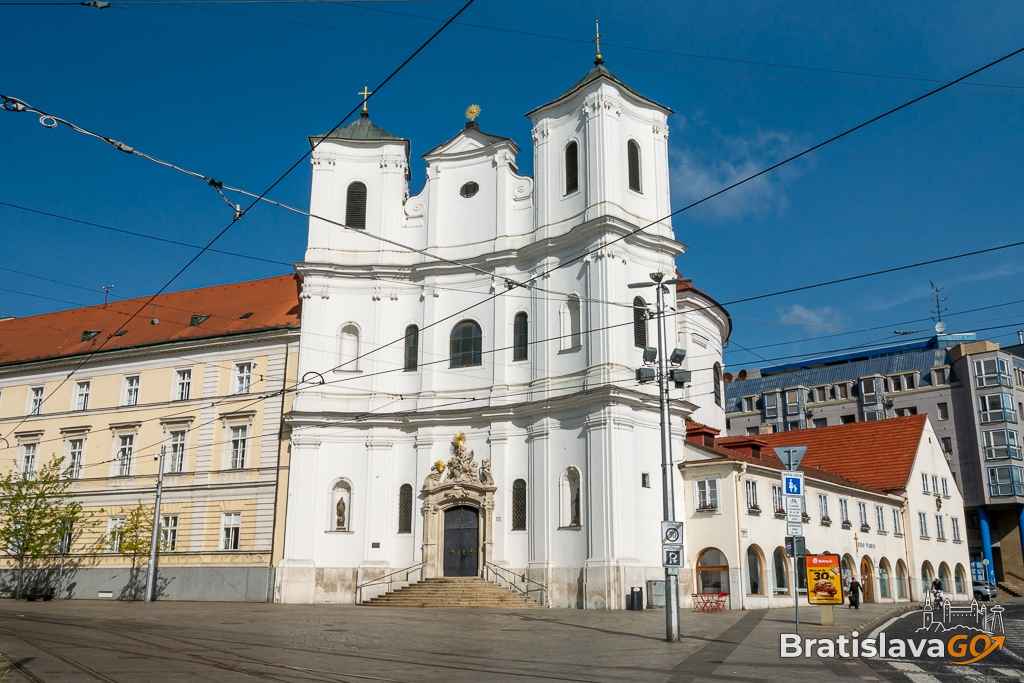
You can find the Church of St. John of Matha at the intersection of Župné Square and Hurbanovo Square, where its uniquely shaped facade creates an attractive backdrop and makes it easy to recognize. This Baroque historic building is characterized externally by its towered design and slightly concave (parabolically curved) front wall. Its origins date back to the early 18th century.
Trojička is very accessible by public transport. The ideal way to reach it is by tram, which stops on Kapucínska Street, or by bus stopping on Staromestská Street. The church can also be visited by bicycle via the city’s cycling network. Parking is limited and paid in this part of the city, so cars are less convenient.
Besides its interesting façade, the church is notable for its unusual oval interior, with three attached chapels on each side. Its name is linked to the Trinitarian Order, founded by St. John of Matha. The order is one of the oldest in Europe.
In Bratislava, the Trinitarians initially had only a small chapel near Michael’s Gate. After acquiring land from a closed cemetery of St. Michael and the Evangelical cemetery, construction of the church and monastery began. The project was likely designed by Johann Lukas von Hildebrandt, with Franz Jänggla overseeing construction. The building phase lasted from 1717 to 1725.
The church forms a striking terminus for the public space at the upper part of Námestie SNP, acting as a wedge between Župné and Hurbanovo Squares. The facade, now painted white, highlights the concave design with two towers. Originally, both towers had classic Baroque onion-shaped roofs, similar to those of Michael’s Gate.
Today, the roofs are simple, shallow, and covered with sheet metal. The facade is relatively unadorned, likely due to budget constraints during construction. The entrance portal is decorated, featuring the inscription “TRES UNUM SUNT” (“Three are one”).
Inside, the church displays classic Baroque decoration. The main altar is monumental, featuring a large painting by German painter Franz Xaver Palk. This altar, however, is not original; it was installed in 1752 by Antonio Galli da Bibbiena.
The painting depicts St. John of Matha and St. Felix of Valois, founders of the Trinitarian Order, redeeming slaves – the primary mission of the order. The altar is framed by four massive, brightly colored Corinthian columns.
Additional elements of the altar include statues of St. Catherine of Alexandria and St. Agnes, created by Viennese sculptor Johann Joseph Resler. The church also features an elaborately decorated pulpit near the altar.
One of Trojička’s treasures is a side altar with the painting of the Miraculous Virgin Mary from 1736, a copy of Albrecht Altdorfer’s Renaissance painting of the Beautiful Virgin Mary. Among the church’s most valuable features is the ceiling, decorated with illusionistic frescoes by Italian artist Antonio Galli da Bibbiena.
The church was originally connected to a monastery, which over time served various functions. After the dissolution of religious orders by Joseph II, it was used as a military hospital and eventually converted into the Župný Dom (County House).
Nearby, visitors can explore the historic building of the Slovak National Council and another significant Bratislava church, the Church of St. Stephen, known as the Capuchins. Michael’s Gate also offers panoramic views over the entire historic center of the city.